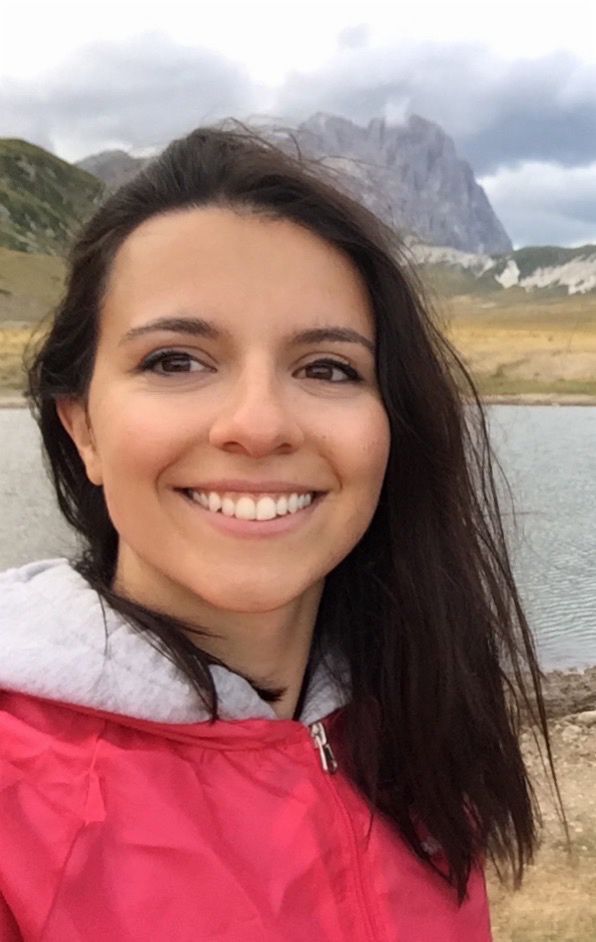
I am a theoretical physicist studying collective properties of non-equilibrium and living systems.
I currently work as a Independent Postdoctoral Researcher at the Laboratoire Matière et Systèmes Complexes (MSC) of Université Paris Cité, with the Walter Benjamin Fellowship of DFG, in Paris, France.
More details on my CV (PDF).
Research
How do living systems self-organize and achieve robust collective behavior?
In my research I explore universal physical mechanisms by which local interactions drive emergent collective phenomena in living matter. For this, I use statistical field theory, agent-based simulations, and hydrodynamic approaches.
Self-organization through non-reciprocity
I study field-theoretical models of two-species systems where action–reaction symmetry is broken. This approach identifies non-equilibrium states of spatial organization that have no equilibrium counterpart and are robust to fluctuations.
Collective behavior of animal groups
From bird flocks to insect swarms, collective motion is achieved through long-range spatio-temporal correlations. I study active-matter models to reproduce quantitative features of these systems.
News
- 08/2025: New preprint out! In Scaling behavior in non-reciprocal and odd conserved dynamics near criticality, we unveil the universality class of conserved nonreciprocal field theories with a challenging RG calculation at two loops!
- 08/2025: Awarded StratEx Université Paris Cité funding MSCA Seal of Excellence 2026.
- 02/2026: Awarded Walter Benjamin Programme Fellowship, DFG.
- 02/2026: Awarded Seal of Excellence for the Marie Skłodowska-Curie PF, score: 96.4/100
Next Talks
- 07/09/2026: Women in Nonequilibrium Statistical Physics, Leuven, NL.
- 22/09/2026: 50 years of Doi-Peliti field theory: applications to critical phenomena, condensed matter physics and active matter, Cambridge, UK.
Selected Publications
Miscellaneous
Co-organizer of the conference Interdisciplinary Challenges in the physics of complexity and life 2026, Cargèse (FR).